

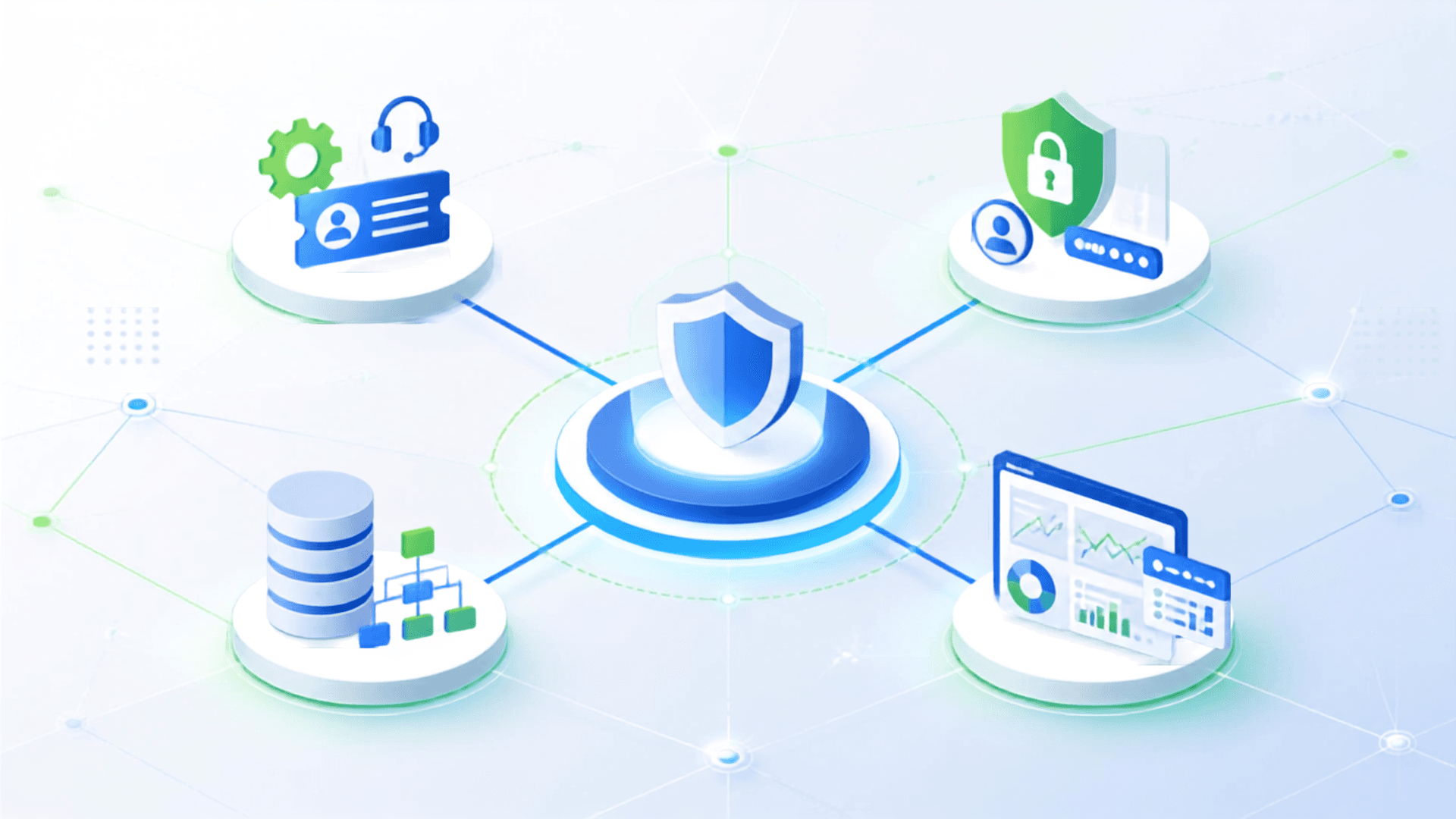
Network cyber resilience shouldn't be isolated. Yet, in most enterprises, it remains disconnected from the ITSM, CMDB, PAM, and observability platforms that manage the rest of IT. This leads to common problems: manual handoffs between teams, gaps in the audit trail, device inventories that don't match reality, and credentials embedded in automation scripts because no other options were available.
Kilter bridges the gap. By integrating directly with the systems that already run your enterprise, ticketing, asset management, credential vaults, monitoring, SD-WAN controllers, and more, Kilter transforms network operations from a siloed function into a trusted, change-aware part of your broader IT governance model.
The Problem With "Integration" Today
Every vendor claims to integrate with the rest of the IT stack. But too often, those integrations stop at basic data exchange or simple ticket creation. They connect systems without connecting workflows, leaving teams to bridge the gaps manually.
- Creating and tracking tickets for backup failures, compliance violations, and security issues, rather than automatically driving remediation workflows.
- Maintaining two device inventories, one for NetOps and one for IT, that quietly drift apart until an automation run fails due to bad data.
- Embedding device credentials directly in scripts poses an audit risk that security teams cannot reasonably approve.
- Manually correlating an observability alert to the configuration change that caused it, hours after the fact.
This is more of a communication failure than a tooling failure. The systems are in place; they just don't communicate in a way that meets business needs.
How Kilter Approaches It Differently
Kilter's approach to integration extends beyond simple data transfer between systems. Instead of creating another set of disconnected connectors, Kilter links network operations workflows across the tools teams already use, reducing manual handoffs and ensuring information stays accurate where it matters.
ITSM. Backup or compliance failures automatically generate tickets. Updates are added without creating duplicates. As remediation progresses, ticket statuses are updated automatically, and resolutions can close the workflow without manual intervention.
CMDB / Asset Management. Kilter continuously synchronizes device attributes like operating systems, interfaces, IP addresses, and hardware details with CMDB and asset management platforms, ensuring operational tools and business systems remain aligned.
PAM. Credentials for CyberArk, HashiCorp Vault, or Delinea are retrieved dynamically at runtime. Nothing is ever stored in Kilter, and every automated action is attributable to a verified identity rather than a shared admin account.
Observability. When an alert triggers, Kilter provides the missing context: what changed, when, and whether it was a planned push, drift, or misconfiguration, turning a multi-hour correlation task into a quick lookup.
SD-WAN / SASE. Modern networks go beyond traditional infrastructure. By using API-driven integrations with platforms such as Cisco Meraki, Prisma Access, and Versa, Kilter adds backup, compliance, configuration management, and drift detection workflows into cloud-managed and distributed environments.
Identity & SSO. OIDC/SAML support for providers like Okta, Azure AD, and PING ensures that network automation access follows the same identity policies as everything else in the IT environment.
Messaging. Network events should not occur in isolation. Kilter can automatically send meaningful notifications and workflow updates to Microsoft Teams, Slack, and other collaboration platforms, keeping stakeholders informed without requiring engineers to manually communicate status.
DevOps. For teams using Ansible and Terraform, Kilter acts as a network-aware execution and validation layer on top of those workflows.
What ties all this together is Kilter's API. It's not just a fixed set of connectors; it's a foundation for tuning workflows, data mappings, and automation logic in minutes rather than weeks, allowing integrations to adapt to how a customer's environment operates rather than forcing that environment to fit the tool.
The Business Outcomes
Taken together, these integrations translate into concrete results:
- Reduce TCO by automating ticket creation, CMDB reconciliation, and credential management.
- Lowered MTTR by linking observability alerts directly to the change context that explains them.
- Audit readiness with a complete, traceable chain from identity to credential source, to execution, and finally to resolution.
- Reduced risk by replacing hard-coded credentials and shared admin accounts with PAM-controlled access.
- Operational continuity, including out-of-band integrations with Opengear, ensures recovery automation continues to work even during outages.
- Hybrid coverage, extending the same capabilities across on-premises, cloud-managed SD-WAN, and SASE environments.
Getting Started
If any of these challenges sound familiar, whether it's manually managing tickets, reconciling conflicting inventories, securing credentials, or chasing down the root cause of an alert, the issue often isn't a lack of tools. It's a lack of workflow integration between them. Knowing which tools are already in use, where the workflow fails, and which stakeholders care about which results is the quickest way to find where Kilter can eliminate friction.
Network cyber resilience works best when it isn't a silo. Integrating Kilter into the rest of your NetOps ecosystem ensures it becomes part of the system of record, connected, auditable, and designed to keep pace as your environment expands.
Explore Kilter integrations or contact an expert to discuss how to gain better visibility into your network using the tools you use daily.
Written by
Kyle Radder